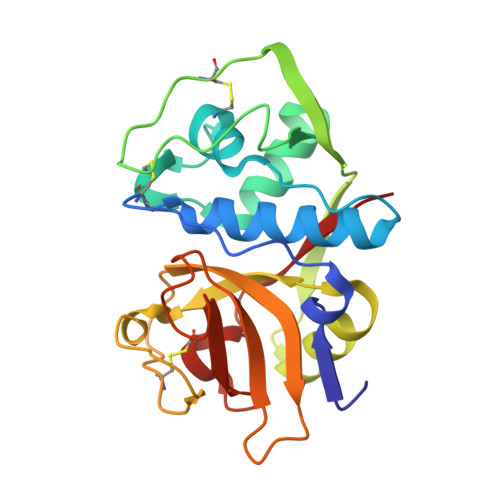
4QH6 | pdb_00004qh6

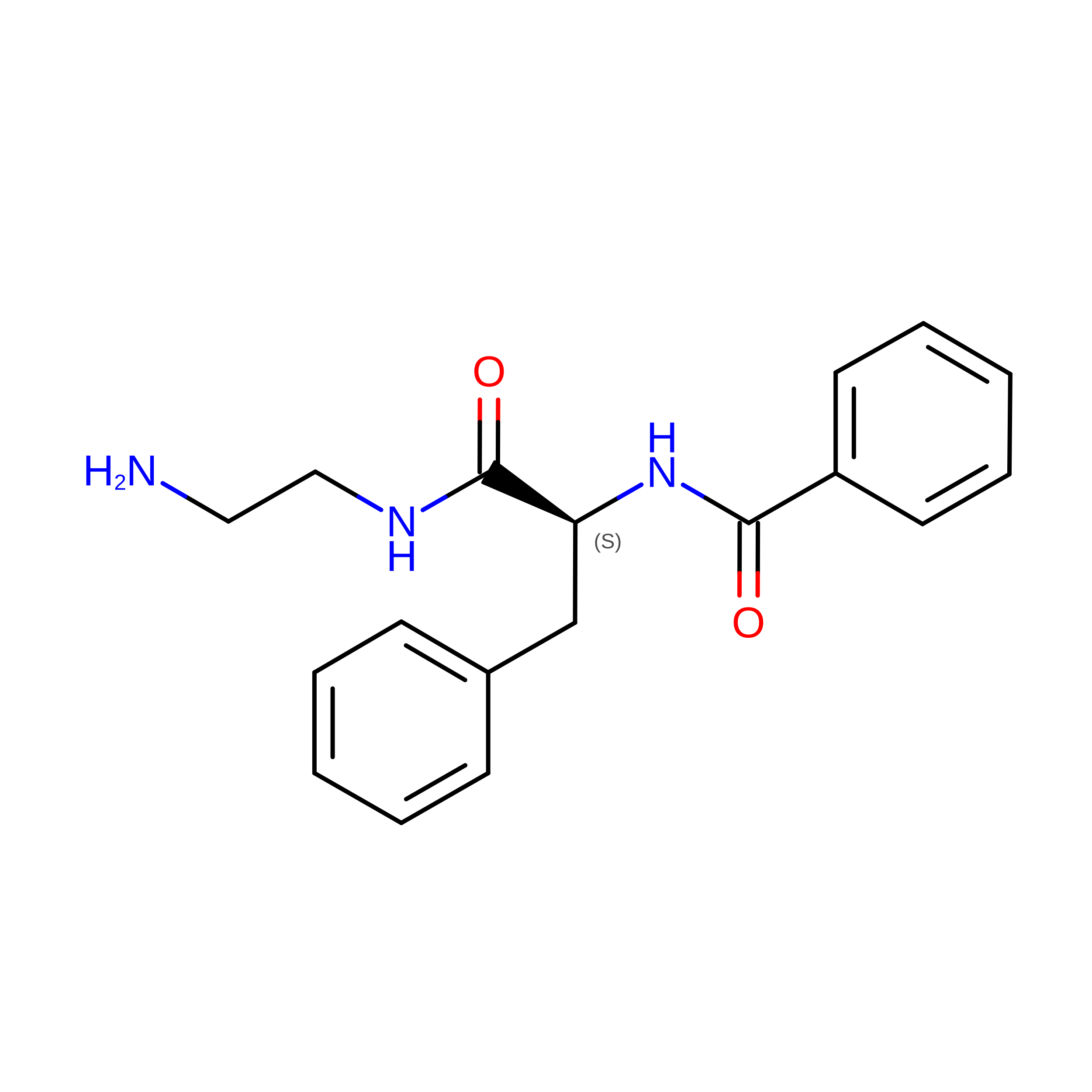
Crystal structure of cruzain with nitrile inhibitor N-(2-AMINOETHYL)-NALPHA-BENZOYL-L-PHENYLALANINAMIDE


Experimental Data Snapshot

  • Method: X-RAY DIFFRACTION
  • Resolution: 3.13 Å
  • R-Value Free: 
    0.244 (Depositor), 0.247 (DCC) 
  • R-Value Work: 
    0.204 (Depositor), 0.207 (DCC) 
  • R-Value Observed: 
    0.206 (Depositor) 

Starting Model: experimental
View more details

wwPDB Validation 3D Report Full Report

Validation slider image for 4QH6

Ligand Structure Quality Assessment 


This is version 1.4 of the entry. See complete history

Literature

Molecular Design, Synthesis and Trypanocidal Activity of Dipeptidyl Nitriles as Cruzain Inhibitors.

Avelar, L.A.Camilo, C.D.de Albuquerque, S.Fernandes, W.B.Goncalez, C.Kenny, P.W.Leitao, A.McKerrow, J.H.Montanari, C.A.Orozco, E.V.Ribeiro, J.F.Rocha, J.R.Rosini, F.Saidel, M.E.

(2015) PLoS Negl Trop Dis 9: e0003916-e0003916

  • DOI: https://doi.org/10.1371/journal.pntd.0003916
  • Primary Citation Related Structures: 
    4QH6

  • PubMed Abstract: 

    A series of compounds based on the dipeptidyl nitrile scaffold were synthesized and assayed for their inhibitory activity against the T. cruzi cysteine protease cruzain. Structure activity relationships (SARs) were established using three, eleven and twelve variations respectively at the P1, P2 and P3 positions. A Ki value of 16 nM was observed for the most potent of these inhibitors which reflects a degree of non-additivity in the SAR. An X-ray crystal structure was determined for the ligand-protein complex for the structural prototype for the series. Twenty three inhibitors were also evaluated for their anti-trypanosomal effects and an EC50 value of 28 μM was observed for the most potent of these. Although there remains scope for further optimization, the knowledge gained from this study is also transferable to the design of cruzain inhibitors based on warheads other than nitrile as well as alternative scaffolds.


  • Organizational Affiliation
    • Grupo de Química Medicinal do IQSC/USP, Instituto de Química de São Carlos, Universidade de São Paulo, São Carlos, São Paulo, Brazil.

Macromolecule Content 

  • Total Structure Weight: 113.89 kDa 
  • Atom Count: 7,983 
  • Modeled Residue Count: 1,075 
  • Deposited Residue Count: 1,075 
  • Unique protein chains: 1

Macromolecules

Find similar proteins by:|  3D Structure
Entity ID: 1
MoleculeChains  Sequence LengthOrganismDetailsImage
Cruzipain
A, B, C, D, E
215Trypanosoma cruziMutation(s): 0 
Gene Names: CruzipainGenBank M84342.1
EC: 3.4.22.51
UniProt
Find proteins for P25779 (Trypanosoma cruzi)
Explore P25779 
Go to UniProtKB:  P25779
Entity Groups
Sequence Clusters30% Identity50% Identity70% Identity90% Identity95% Identity100% Identity
UniProt GroupP25779
Sequence Annotations
Expand
Reference Sequence

Small Molecules

Ligands 1 Unique
IDChains Name / Formula / InChI Key2D Diagram3D Interactions
33L

Query on 33L


Download:Ideal Coordinates CCD File
F [auth A]N-(2-aminoethyl)-Nalpha-benzoyl-L-phenylalaninamide
C18 H21 N3 O2
WNPRWIUDHVJPCD-INIZCTEOSA-N

Experimental Data & Validation

Experimental Data

  • Method: X-RAY DIFFRACTION
  • Resolution: 3.13 Å
  • R-Value Free:  0.244 (Depositor), 0.247 (DCC) 
  • R-Value Work:  0.204 (Depositor), 0.207 (DCC) 
  • R-Value Observed: 0.206 (Depositor) 
Space Group: P 43 21 2
Unit Cell:
Length ( Å )Angle ( ˚ )
a = 137.79α = 90
b = 137.79β = 90
c = 166.48γ = 90
Software Package:
Software NamePurpose
PHASERphasing
PHENIXrefinement
ELVESrefinement
XDSdata reduction
XSCALEdata scaling

Structure Validation

View Full Validation Report


Ligand Structure Quality Assessment 


Entry History 

Deposition Data

Revision History  (Full details and data files)

  • Version 1.0: 2015-08-05
    Type: Initial release
  • Version 1.1: 2015-12-16
    Changes: Database references
  • Version 1.2: 2017-11-22
    Changes: Refinement description
  • Version 1.3: 2023-09-20
    Changes: Data collection, Database references, Derived calculations, Refinement description
  • Version 1.4: 2024-10-09
    Changes: Structure summary